
You've tried box breathing. You've done the 4-7-8. Maybe you've even downloaded a breathing app. And yet, when the pressure really builds, whether it's the relentless pace of work, the mental load that never quite switches off, or that low-level hum of anxiety that follows you everywhere, the basics just don't cut it anymore. That's not a failure on your part. It's a sign you're ready for something that works at a deeper level. This guide walks you through advanced breathwork in a practical, honest way, rooted in current clinical evidence and designed to keep you safe while you progress.
Table of Contents
- What is advanced breathwork? Definitions and clinical context
- Preparation: What you need before starting advanced breathwork
- Step-by-step: The advanced breathwork process in practice
- Troubleshooting and ensuring safety during advanced breathwork
- How to track progress: Measuring results and making adjustments
- Why safety-first innovation matters in advanced breathwork
- Want expert guidance? Breathwork support for your next step
- Frequently asked questions
Key Takeaways
| Point | Details |
|---|---|
| Safety above all | Advanced breathwork requires careful preparation and awareness of risks for safe practice. |
| Start slow for results | Evidence suggests slow, controlled techniques offer more benefits and fewer side effects than fast or experimental methods. |
| Track and adjust | Monitor your emotional and physical responses over time and be ready to adjust your approach for best results. |
| Professional support can help | Guidance from experienced practitioners enhances both safety and effectiveness, especially for complex methods. |
What is advanced breathwork? Definitions and clinical context
Before we explore the hands-on technique, it's essential to understand what sets advanced breathwork apart from familiar methods.
Most people start breathwork with slow, relaxed breathing patterns. That's a solid foundation. Advanced breathwork builds on this by deliberately influencing your autonomic nervous system through more precise interventions, including varied breath ratios, controlled breath retention, and specific pranayama patterns. The goal is the same as it's always been, to bring your body out of threat mode and back to baseline, but the tools are sharper and require more awareness.
One concept you'll encounter quickly is CO2 sensitivity. Your brain monitors carbon dioxide levels constantly, and changes in CO2 directly affect blood vessel dilation, oxygen delivery, and the sense of calm or panic you feel. Clinically, hyperventilation is defined as alveolar ventilation increased out of proportion to CO2 production, lowering arterial CO2 below 36 mmHg (4.8 kPa). That's the physiological line between normal and problematic breathing. Understanding this matters, because crossing it unintentionally during practice is easier than people think.
Here's a quick overview of the main categories of advanced breathwork:
| Method | Speed | Primary effect | Risk level |
|---|---|---|---|
| Slow pranayama (e.g., nadi shodhana) | Slow | Parasympathetic activation, calm | Low |
| Kapalabhati (breath of fire) | Fast | Energising, can raise alertness | Moderate |
| Breath retention (kumbhaka) | Varied | CO2 and O2 modulation | Moderate to high |
| CO2 inhalation protocols | Experimental | Research context only | High |
Key distinctions to carry with you:
- Slow techniques are better supported by current evidence for everyday nervous system regulation
- Fast techniques are associated with more adverse events in clinical research
- Experimental CO2 methods are not established as safe or effective for general use
- The Buteyko method overview offers one well-known framework for CO2 and nasal breathing optimisation
Advanced does not mean extreme. It means precise, intentional, and well-informed.
Preparation: What you need before starting advanced breathwork
With a strong grasp of the terms and principles, effective breathwork begins with thorough preparation.
This is the part most people skip, and it's where things can go wrong. Preparation is not just about finding a quiet room. It's about knowing your own body, your current health status, and the specific demands of the technique you're about to use. Think of it like this: you wouldn't attempt a long open-water swim without checking the conditions first. The same logic applies here.
Environmental and practical checklist:
- A quiet, private space where you won't be disturbed for at least 20 minutes
- Comfortable, loose-fitting clothing that allows full diaphragmatic breathing
- A mat or supportive surface to lie or sit on
- A glass of water nearby
- A journal or notes app to record observations afterwards
When not to practise advanced breathwork:
- During or after heavy alcohol consumption
- If you have a diagnosed cardiovascular condition, without medical clearance
- If you're pregnant, particularly with breath retention techniques
- If you're currently in acute psychological distress or crisis
- If you have epilepsy or a history of seizures
It's also worth reviewing breathwork prerequisites if you have a respiratory condition like asthma. Certain techniques can genuinely aggravate symptoms if not adapted properly.
Safety note: CO2 inhalation methods, sometimes promoted online as anxiety treatments or performance tools, carry significant risks. A recent review found that CO2 inhalation frequently induces dyspnoea, anxiety, and cognitive disruption, concluding that risks in healthy individuals often outweigh potential benefits and that safe, effective protocols are not fully established. Avoid these methods outside a supervised medical or research setting.
Emotional preparation matters too. If you've had a particularly difficult week or you're carrying unresolved tension, that's not necessarily a barrier to practice, but it is something to be aware of. Start shorter. Stay grounded. Many people find that everyday breathwork adjustments in ordinary life moments help build the readiness for deeper work.
Step-by-step: The advanced breathwork process in practice
You've checked your readiness. Now you're prepared to practise, step by step.
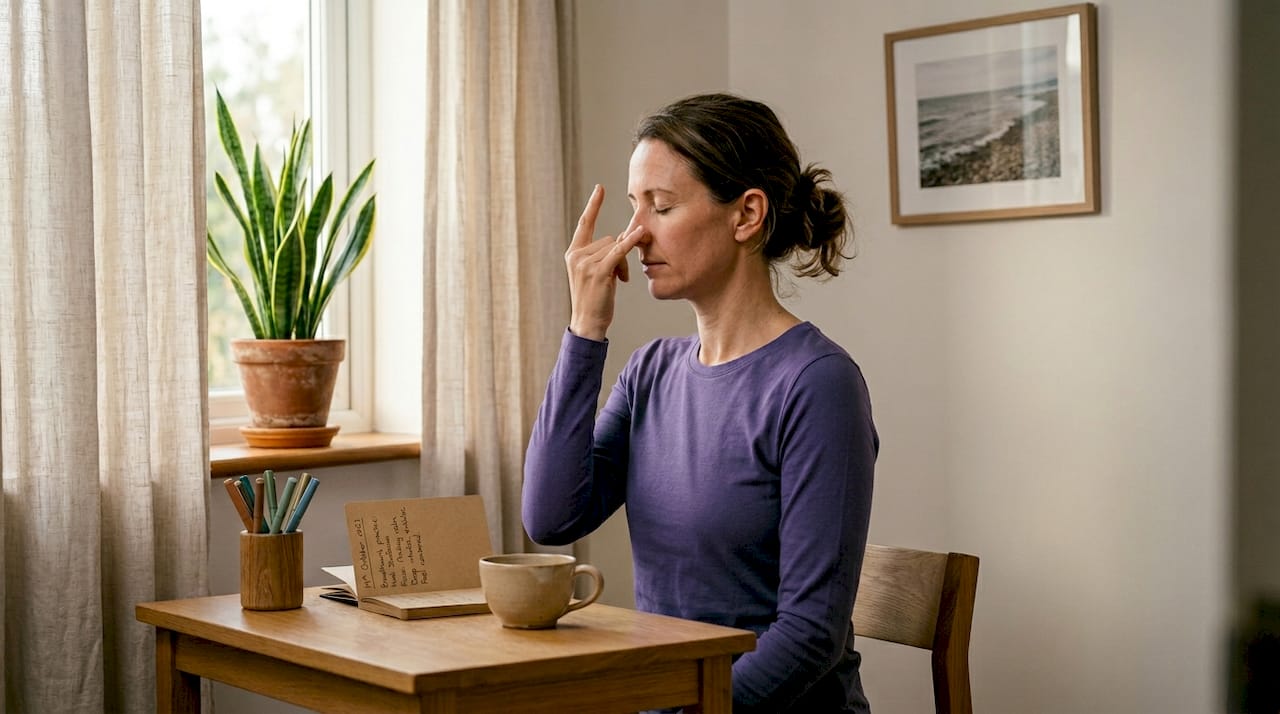
We're going to focus on a slow advanced pranayama session, specifically a structured alternate nostril breathing pattern with extended exhalation and a brief retention phase. This approach is one of the better-evidenced options for stress and anxiety regulation.
Research on pranayama, drawing from a synthesis of six RCTs involving 517 participants, shows small-to-medium short-term symptom reductions for conditions including PTSD and mixed non-psychotic disorders, with adverse events reported more frequently with fast breathing techniques. Slow techniques, like what we describe below, carry a more favourable safety profile.
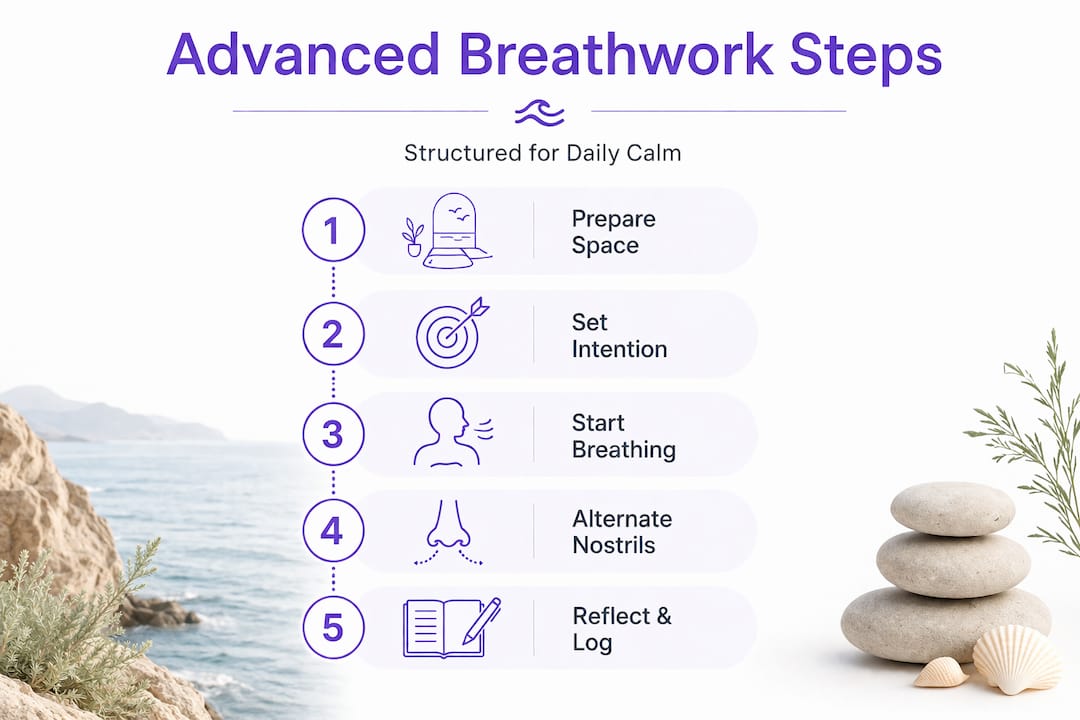
Step-by-step: A 15-minute slow advanced session
-
Settle in (2 minutes). Sit upright with your spine supported, hands resting on your thighs. Close your eyes. Take three natural breaths without controlling anything, simply observing your current baseline rhythm.
-
Diaphragmatic activation (3 minutes). Place one hand on your chest and one on your belly. Breathe in through your nose for a count of 4, ensuring your belly rises first before your chest. Exhale slowly through your nose for a count of 6. Repeat this consistently for three minutes.
-
Introduce the extended ratio (5 minutes). Shift to a 4-count inhale, a 2-count pause at the top (no straining, just a gentle hold), and an 8-count exhale. This extended exhalation is the core mechanism here. It activates the vagus nerve and shifts the body toward parasympathetic dominance. Do this for at least ten breath cycles.
-
Add alternate nostril technique (3 minutes). Use your right hand. Close your right nostril with your thumb, inhale through the left for 4 counts, close both briefly, release the right nostril and exhale for 6 counts. Inhale through the right for 4 counts, close both briefly, exhale through the left for 6 counts. That's one cycle. Aim for five to eight cycles.
-
Return to natural breathing (2 minutes). Release any technique. Simply breathe. Notice whether your heart rate has slowed, your jaw has unclenched, or your thoughts have quietened. These are signs of genuine regulation, not just distraction.
Pro Tip: Keep a simple notes log after each session. Write down your stress level before (1 to 10), your stress level after, any sensations you noticed, and whether anything felt uncomfortable. This data becomes genuinely useful after several weeks. It also grounds breathwork and neurodiversity considerations, since many neurodivergent individuals find that structured self-monitoring makes breathwork feel safer and more predictable.
If you're curious how breathwork connects to other therapeutic approaches, CBT and breathwork integration explores exactly how these tools complement each other in practice.
Troubleshooting and ensuring safety during advanced breathwork
While advanced breathwork is powerful, it's not without challenges. Here's how to handle them confidently.
The most common sensations people report during advanced breathwork are dizziness, tingling in the hands or face, a feeling of emotional pressure, or a sudden wave of fatigue. Most of these are normal and temporary. But not all sensations are safe to push through.
Common experiences and what they mean:
- Mild dizziness: Usually a CO2 shift from altered breathing rhythm. Slow down, breathe more naturally for a minute.
- Tingling in fingers or lips: A sign of mild hypocapnia (lower CO2). Return to a slower, smaller breath.
- Emotional welling or tears: Quite normal. Common emotional responses during breathwork don't require analysis in the moment. Simply breathe gently and allow the feeling to pass.
- Anxiety spike: Stop the technique and return to a natural rhythm. Ground yourself by pressing your feet firmly into the floor.
- Chest tightness or palpitations: Stop immediately. These are signals to take seriously.
Important: Fast or experimental breathing methods carry a disproportionate risk of adverse events. The evidence is clear that risks in healthy individuals from CO2-altering protocols can outweigh the benefits, and safe training guidelines simply don't yet exist for general populations. If a practitioner or online resource is pushing you towards intensity without checks, that's a red flag.
A simple grounding reset if things feel too much:
- Stop the technique entirely
- Open your eyes and look around the room, naming five things you can see
- Press both feet flat on the floor
- Take three slow, natural breaths without counting
- Drink some water
You don't have to finish every session perfectly. Knowing when to stop is a skill, not a weakness.
How to track progress: Measuring results and making adjustments
Solid results rely on reflection. Here's how you check your progress and refine your approach.
Tracking isn't about performance. It's about pattern recognition. When you log how you feel before and after each session, over time you start to see what's working and what isn't. That honest data is far more useful than any subjective feeling in the moment.
Simple session tracker template:
| Date | Pre-session stress (1-10) | Post-session stress (1-10) | Technique used | Notable sensations |
|---|---|---|---|---|
| Example | 7 | 4 | Alternate nostril, 4-2-8 | Slight tingling, then calm |
Use this for at least three to four weeks before drawing conclusions. According to a meta-analysis of pranayama research covering 517 participants, the effect sizes for symptom reduction are real but modest in the short term, with standardised mean differences around 0.27 to 0.35 compared to passive controls. That's meaningful. But it's also incremental. Expect gradual shifts, not overnight transformation.
Signs you may need to adjust your approach:
- Your stress levels are consistently the same or higher after sessions
- You feel emotional discomfort that lingers for hours after practice
- You're dreading sessions rather than looking forward to them
- You're experiencing physical symptoms like headaches or nausea regularly
These are not signs to give up. They're signals to recalibrate. Shorten your sessions, simplify the technique, or consider whether everyday breathwork assessment in lower-stakes moments might build a better foundation before you return to more structured practice.
Also worth noting: the research shows no significant effect for depression in the pranayama synthesis. If depression is a primary concern for you, breathwork alone is unlikely to be sufficient. Please seek appropriate clinical support alongside any self-directed practice.
Why safety-first innovation matters in advanced breathwork
Reflecting on your results can reveal broader principles. Here's our perspective on advanced breathwork's future.
There's a temptation, especially online, to treat breathwork like a biohacking tool. More intensity equals more benefit. Hold longer. Breathe faster. Push harder. We understand the appeal. When you're dealing with chronic stress, the idea of a powerful technique that delivers fast results is genuinely attractive.
But this framing misunderstands what breath regulation actually does. The breath is a lever for the nervous system, and levers can work in both directions. Advanced does not mean aggressive. The most skilled practitioners we encounter aren't the ones who can hold their breath the longest. They're the ones who can detect the earliest signs of dysregulation in themselves and respond with precision rather than force.
The rise of experimental and high-intensity breathwork methods over the past decade has produced some remarkable claims and some genuine harm. We've worked with people who came to us after distressing experiences with poorly guided intense sessions. The pattern is consistent: someone pushed past their window of tolerance without proper scaffolding, and the nervous system responded accordingly.
Our view is that trauma-aware, evidence-informed practice means building slowly, respecting physiological limits, and being honest about what the research does and doesn't support. Multi-method regulation approaches, combining breathwork with mindfulness, bodywork, or grounding practices, often outperform any single technique precisely because they meet people where they are rather than where a protocol assumes they should be.
The real art of this work lies in incremental progression and honest self-reflection. That's not a limitation. It's the whole point.
Want expert guidance? Breathwork support for your next step
If you've worked through this guide and you're ready to go further, it helps to have structured support rather than piecing things together alone.
At Low Tide Calm, we offer one-to-one online sessions and structured programmes rooted in current evidence and adapted to your nervous system and life circumstances. Whether you're starting from scratch or refining techniques you've already begun, our sessions are trauma-aware, neurodivergent-friendly, and genuinely paced to your needs. You can also explore our mindfulness resources as a complementary layer to your breathwork practice. And if you have a specific health consideration, our focused breathwork support pages cover practical adaptations. This isn't about selling you a quick fix. It's about building something that actually holds up under pressure.
Frequently asked questions
What is the difference between advanced and basic breathwork?
Advanced breathwork involves more complex timing, breath retention, specific ratios, and physiological awareness, while basic breathwork usually focuses on slow, relaxed breathing without retention. The difference is also in the degree of CO2 and nervous system influence, since physiological hyperventilation is defined by measurable arterial CO2 changes that advanced techniques can approach if not practised carefully.
Is advanced breathwork safe for everyone?
Advanced breathwork is not suitable for everyone. Rapid techniques and CO2-altering methods in particular carry risks, and a recent review found that these methods frequently induce dyspnoea, anxiety, and cognitive disruption, particularly in healthy individuals without medical supervision.
What results can I expect from advanced breathwork?
You may notice short-term reductions in stress and improved calm after several consistent sessions, though effects vary between individuals. Evidence from pranayama RCT synthesis shows real but modest effects, with no significant impact on depression specifically and some risk of discomfort if fast techniques are used.
How often should I practise advanced breathwork?
Start with short, slow sessions two to three times per week and build gradually based on how your body and mood respond. Consistent, manageable practice is far more effective than occasional intense sessions.
Recommended
- Breathwork for Asthma - Improve Your Breathing - Buteyko Method - Low Tide Calm
- Breathwork in Real Life: 6 Mundane Moments That Work
- What to do when breathwork makes you cry
- Breathwork & Mindfulness for Neurodivergent Minds
- Krok po kroku redukcja stresu: praktyczny przewodnik
- Ghid complet pentru reducerea stresului: strategii eficiente