

TL;DR:
- Evidence-based mindfulness involves structured protocols with proven outcomes from rigorous research, focusing on specific populations. It is effective for managing burnout and stress, especially when adapted for neurodivergent needs; however, it should be part of a broader approach. Practitioners should verify programmes have clear research backing, defined targets, and tailored delivery to ensure genuine benefit.
Mindfulness has a reputation problem. Somewhere between the wellness industry and the corporate wellbeing seminar circuit, it got tangled up with scented candles, chakras, and the vague instruction to "just breathe." If you've dismissed it on those grounds, that's understandable. But there's a different version of mindfulness that looks nothing like that: structured, research-validated and built around measurable outcomes. This guide covers what evidence-based mindfulness actually means, why it matters for professionals dealing with burnout, and how it can be adapted for neurodivergent minds that standard programmes tend to leave behind.
Table of Contents
- What does 'evidence-based mindfulness' actually mean?
- How mindfulness-based interventions work and what the research shows
- Adapting mindfulness for neurodivergent professionals
- How to choose and use evidence-based mindfulness in real life
- A practical perspective: what most guides miss about mindfulness for professionals
- Support for mindfulness and neurodiversity: where to start
- Frequently asked questions
Key Takeaways
| Point | Details |
|---|---|
| Structured and research-backed | Evidence-based mindfulness means specified programmes supported by research, not just informal experiences. |
| Modest, targeted benefits | Mindfulness can reduce burnout and stress, but effects are moderate and vary for each individual. |
| Essential adaptations | Neurodivergent professionals benefit most from adapted, skills-focused mindfulness and accessible delivery. |
| Beware universal claims | Programmes should be chosen for fit and research support; mindfulness is not a cure-all. |
What does 'evidence-based mindfulness' actually mean?
The phrase gets used loosely, so let's be direct about what it means and what it doesn't.
Evidence-based mindfulness refers to structured, named protocols that have been studied through randomised controlled trials, systematic reviews, or meta-analyses. It is not a mood, a lifestyle habit, or a general sense of being present. The distinction matters because the research evidence attaches to specific programmes, not to the idea of mindfulness in general.
It's also worth separating two things that often get conflated. Mindfulness is a quality of attention: a metacognitive, sustained, non-judgmental awareness of what's happening in the present moment. Meditation is one method of training that quality. You can practise mindfulness without sitting cross-legged in silence. You can meditate without developing any meaningful mindfulness at all. The two aren't the same thing.
"Evidence-based mindfulness" means a named protocol, a defined target outcome, and published research supporting its use. Anything short of that is a claim, not evidence.
So what qualifies in practice? The most widely studied programmes are Mindfulness-Based Stress Reduction (MBSR), developed by Jon Kabat-Zinn, and Mindfulness-Based Cognitive Therapy (MBCT), which was designed specifically for recurrent depression. Both involve structured weekly sessions, specific skills training, guided practice, and defined outcome measures.
| Programme | Primary target | Typical format | Research base |
|---|---|---|---|
| MBSR | Stress, chronic pain, general wellbeing | 8 weeks, group, 2.5 hrs/session | Extensive |
| MBCT | Recurrent depression, anxiety | 8 weeks, group, 2 hrs/session | Extensive |
| Adapted MBIs | Burnout, neurodivergence, specific populations | Varies | Growing |
The evidence for mindfulness approaches is genuinely substantial. A VA Evidence-Based Synthesis Program review identified 81 unique systematic reviews on mindfulness interventions, covering conditions from chronic pain and anxiety to sleep problems and substance use. That's not trivial. It means there's a body of rigorous research worth taking seriously, as long as you're looking at the right thing.
What doesn't qualify as evidence-based: a wellness app with no published trials behind it, a workshop described only as "mindfulness-inspired," or a practitioner who invokes "the science" without specifying which studies, which populations, and which outcomes. Vagueness is a red flag.
How mindfulness-based interventions work and what the research shows
Mindfulness-based interventions, or MBIs, are designed to train specific cognitive and emotional skills. They're not passive relaxation techniques. A structured MBI session typically involves attention training, body awareness work, inquiry (reflecting on your experience), and skills practice between sessions.

For professionals dealing with burnout, the relevant mechanisms include reducing rumination, improving attentional control, increasing tolerance for distress, and building a more flexible relationship with difficult thoughts and feelings. These aren't abstract goals. Burnout involves specific patterns of cognitive overload, emotional blunting, and disengagement, and MBIs target several of those patterns directly.
Here's how a typical evidence-based protocol is structured:
- Assessment and orientation — clarifying the participant's situation, contraindications, and what the programme involves.
- Attention training — early sessions focus on anchoring attention and noticing when the mind wanders, without self-criticism.
- Body awareness — developing a non-reactive relationship with physical sensations, which is particularly relevant for people who've learned to override or ignore bodily stress signals.
- Cognitive skills — learning to observe thoughts as mental events rather than facts, reducing their grip.
- Emotion regulation — building capacity to sit with difficult feelings rather than suppress or react impulsively.
- Integration and relapse prevention — applying skills to real-world situations and planning for high-pressure periods.
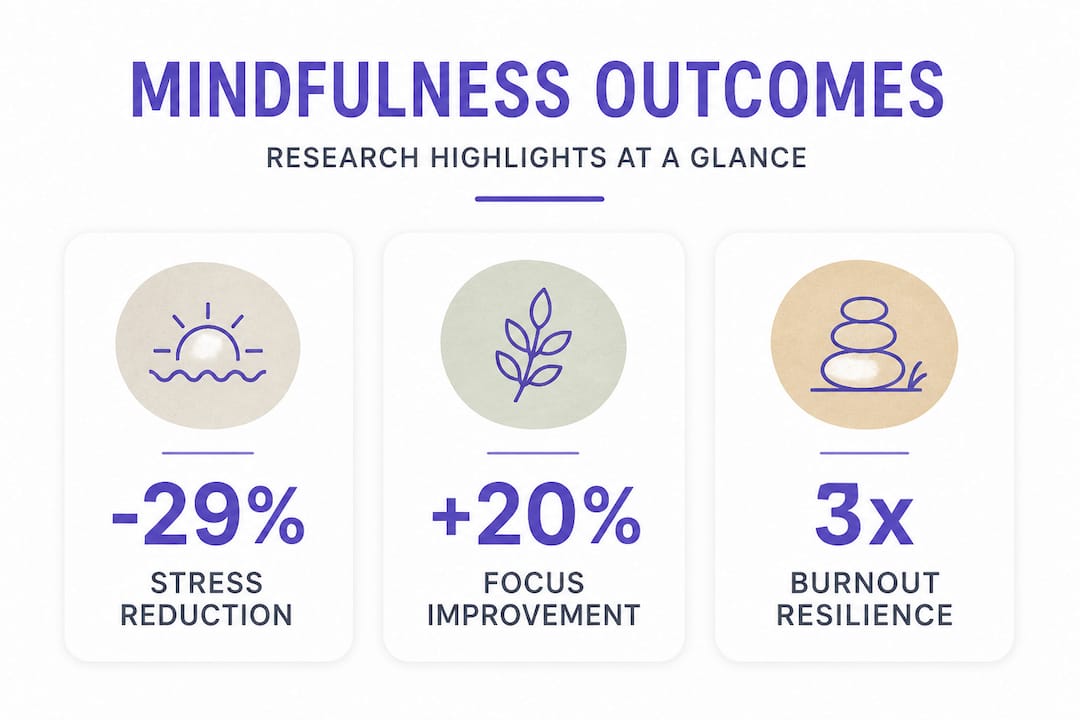
The research picture is encouraging but not without nuance. Evidence from systematic reviews suggests MBIs can reduce burnout-related outcomes in healthcare professionals, but effect sizes are generally modest and evidence quality varies considerably across studies. That's an honest summary. It means mindfulness can help, but it's not going to fix a broken work environment on its own.
| Outcome | Direction of evidence | Confidence level |
|---|---|---|
| Perceived stress | Positive, consistent | Moderate to high |
| Emotional exhaustion | Positive, modest | Moderate |
| Anxiety | Positive, consistent | Moderate to high |
| Depersonalisation | Mixed | Low to moderate |
| Overall burnout | Modest improvement | Moderate |
Heterogeneity is a real issue in this research area. Studies vary in which MBI they used, how many sessions, whether delivery was group or individual, and how outcomes were measured. That makes direct comparisons difficult. Mindfulness pathways for stress relief look different depending on the individual, their work context, and whether the underlying causes of burnout are also being addressed.
The honest framing here is that MBIs work best as part of a broader response to burnout, not as a standalone fix. Multi-modal approaches to burnout that combine mindfulness with breathwork, body-based practices, and practical lifestyle changes tend to be more sustainable than any single intervention.
Adapting mindfulness for neurodivergent professionals
Standard mindfulness protocols were not designed with neurodivergent people in mind. That's not an opinion, it's fairly obvious from how they're structured: long sessions in groups, extended periods of sitting still, open-ended instructions like "notice your thoughts," and an implicit expectation that participants can regulate their attention on demand. For someone with ADHD or autism, those conditions can make the intervention actively counterproductive.
This matters because neurodivergent professionals are significantly represented among people experiencing burnout. Many have spent years masking, overcompensating, and operating in environments designed for a different kind of nervous system. The burnout is often deeper and more complex as a result.
In neurodivergent contexts, evidence-based mindfulness is typically approached as a practical skills and training intervention with adapted delivery. That means shorter sessions, more explicit instructions, sensory considerations, and flexibility around what "practice" looks like. It means not insisting that someone close their eyes if that's uncomfortable. It means offering clear structure rather than open-ended contemplation.
Practical adaptations that make a real difference include:
- Shorter, more frequent sessions rather than long blocks that demand sustained attention
- Explicit step-by-step instructions rather than vague prompts
- Movement-based or sensory anchors as alternatives to breath focus (particularly relevant for those with trauma history or interoceptive differences)
- Written or visual supports alongside audio guidance
- Low-demand language that frames practice as optional rather than obligatory
- Named, predictable session structure to reduce cognitive load from uncertainty
Mindfulness for neurodivergent minds also requires practitioners to understand that the potential challenges for neurodivergent people in mainstream programmes are real. Some people find that certain mindfulness practices temporarily increase anxiety or sensory discomfort. That's not a personal failing. It's feedback that the approach needs adjusting.
App-based adaptations are one area where the research is developing positively. A recent randomised controlled trial found that an adapted app-based mindfulness intervention showed meaningful improvements in stress and anxiety for autistic adults. The key factor was accessibility: self-paced, visually supported, and delivered without the group dynamics that many autistic people find overwhelming.
Pro Tip: If standard mindfulness hasn't worked for you, the problem is probably the format, not your capacity for mindfulness. Look for programmes that explicitly acknowledge neurodivergent needs and offer structural flexibility rather than expecting you to adapt to them.
You can explore neurodivergent support resources to get a clearer sense of what adapted approaches look like in practice.
How to choose and use evidence-based mindfulness in real life
With so much out there claiming to be evidence-based, it helps to have a clear checklist. Here's a practical way to evaluate any mindfulness programme or practitioner before committing time and money.
- Can they name the protocol? MBSR, MBCT, and a small number of validated adaptations have published research behind them. If the programme has no name or a vague description, that's worth questioning.
- Is there a defined target outcome? Stress, anxiety, burnout, depression relapse prevention: good programmes are specific about what they're designed to address and for whom.
- Is there a research reference you can check? A credible practitioner should be able to point to the evidence base without evasion. If they cite "studies" without specifics, ask which ones.
- Is delivery structured and consistent? Session format, skills progression, and measurable outcomes should all be clearly described. Not vague. Not entirely tailored on the fly.
- Are limitations acknowledged? Any practitioner or programme that claims universal benefit is either uninformed or selling something. Mindfulness training effects depend on programme components, not just time spent, and overstated claims are a known problem in the field.
One thing to watch for is the "one-size-fits-all" pitch. If a programme makes grand promises without asking anything about your background, work context, or previous experience with mindfulness, that's a practical red flag. What works for a generally stressed professional may be completely wrong for someone with a trauma history, ADHD, or a physical health condition that affects breathing.
Mindfulness for sceptical professionals is a reasonable position to take. Healthy scepticism is actually a useful starting point because it pushes you towards the evidence rather than away from it. The goal is to find something that has been tested, is honest about its limits, and fits your actual situation.
Pro Tip: Combining a structured MBI with other regulation skills, such as breathwork or body-based practices, generally produces better results than mindfulness alone. Think of it as building a toolkit rather than finding a single solution. Emotional regulation approaches that stack multiple methods tend to be more robust across high-pressure or unpredictable environments.
Your daily mindfulness routines don't need to be elaborate. Consistency over duration is generally more valuable, especially in early stages of practice.
A practical perspective: what most guides miss about mindfulness for professionals
Most articles about evidence-based mindfulness stop at listing the research findings and leave you with the impression that if you just follow the right protocol, everything will settle. That's not quite honest.
Here's what I've observed, both from working with people and from my own experience of burnout and ADHD: mindfulness is a skill that can make a genuine difference, but only when it's matched to the individual. The research agrees. Claims that mindfulness works universally are misleading, and the honest reading of the evidence is that it helps some people, in some contexts, with some outcomes, when delivered in the right format.
The professionals who get the most out of it tend to share a few things in common. They're not looking for a cure. They've accepted that their burnout or anxiety has multiple causes, and they're building a set of skills to manage their nervous system better over time. They experiment without catastrophising when something doesn't immediately click. And they don't treat a bad first experience with a group MBSR course as the final word on whether mindfulness can work for them.
The unexpected mindfulness benefits that practitioners often report aren't dramatic revelations. They're quiet shifts: noticing earlier when stress is building, recovering slightly faster after a difficult day, being a bit less reactive in a tense meeting. That's not nothing. But it takes time, realistic expectations, and an approach that actually suits how your brain works.
If you're neurodivergent, that last point matters even more. Self-compassion in this context isn't a platitude. It means genuinely allowing yourself to adapt the practice rather than trying to force a fit that isn't there.
Support for mindfulness and neurodiversity: where to start
If you're a professional dealing with burnout, or a neurodivergent person who's tried mainstream mindfulness and found it inaccessible, structured one-to-one support tends to work better than group programmes or self-guided apps alone. At Low Tide Calm, the ongoing mindfulness programmes are trauma-aware and choice-based, built around what actually works for your nervous system rather than a fixed template. The Mindfulness-Only Programme (6 sessions, €300) is specifically designed without breath manipulation, making it suitable for those who find breathwork uncomfortable. There are also session options for neurodivergent professionals that explicitly account for ADHD, autism, and sensory differences. You can review full pricing and session information to find a starting point that fits.
Frequently asked questions
Is evidence-based mindfulness suitable if I dislike meditation?
Yes. Mindfulness is distinguished from meditation in the research literature, and evidence-based approaches can focus on attention training, emotion regulation, and practical skills without requiring you to sit in formal meditation at all.
Are there mindfulness programmes backed by research for autistic or neurodivergent professionals?
Yes. App-based mindfulness RCTs for autistic adults have shown meaningful reductions in stress and anxiety, particularly when delivery is adapted for accessibility and self-paced engagement.
How strong is the evidence that mindfulness helps with burnout?
The evidence is encouraging but modest. Burnout improvements are modest and evidence quality varies, so mindfulness is best understood as one useful tool rather than a complete solution.
What makes a mindfulness practice 'evidence-based'?
It follows a named protocol with measurable outcomes and is supported by published research, typically randomised controlled trials or systematic reviews, rather than general claims about mindfulness in the abstract.
Recommended
- Mindfulness for Stress: What the Evidence Shows
- Your guide to trauma-aware mindfulness for stress and resilience
- Understanding mindfulness pathways for stress relief
- Mindfulness Ireland - Calm Your Mind Daily - Low Tide Calm
- What is mindfulness therapy? Benefits, methods, and tips – Lunix
- Mindfulness for cancer patients: A practical guide to healing