

You're sitting at your desk before a big meeting, chest tightening, and someone suggests you "just breathe and be present." So you try it. You close your eyes, focus inward, and within seconds something feels wrong. Your heart rate climbs instead of drops. Your mind floods. Sound familiar? For people carrying trauma histories or navigating neurodivergent experiences, standard mindfulness advice can backfire in exactly this way. Trauma-aware mindfulness offers a genuinely different path, one built around safety, choice, and your nervous system's actual needs rather than a one-size-fits-all instruction to sit still and observe.
Table of Contents
- Understanding trauma-aware mindfulness
- Preparing for trauma-aware mindfulness
- Trauma-aware mindfulness: step-by-step guide
- Troubleshooting and common mistakes
- Recognising progress and building resilience
- A fresh perspective on trauma-aware mindfulness
- Next steps: expert support for trauma-aware mindfulness
- Frequently asked questions
Key Takeaways
| Point | Details |
|---|---|
| Safety first | Trauma-aware mindfulness prioritises your sense of safety and choice at all times. |
| Tiny practices help | Short, movement-based and eyes-open practices are often more effective and less triggering. |
| Monitor for discomfort | It’s normal to feel unease at first—stop or adapt if you feel overwhelmed. |
| Track real progress | Notice emotional, cognitive, and nervous system changes, not just calmness or relaxation. |
| Professional support matters | Work with trauma-aware guides or therapists for safer and more resilient outcomes. |
Understanding trauma-aware mindfulness
To build a safer foundation for your practice, it's important to first understand how trauma-aware mindfulness differs from traditional mindfulness.
Trauma-aware mindfulness is not a watered-down version of mindfulness. It is a thoughtful adaptation grounded in established trauma-informed principles. SAMHSA's trauma-informed framework outlines five core principles: safety, trustworthiness, choice, collaboration, and empowerment. When these principles are woven into mindfulness practice, the result is something that genuinely supports people rather than inadvertently retraumatising them.
Standard mindfulness, as it's often taught in apps or group classes, tends to assume a relatively settled nervous system. It asks you to close your eyes, focus on your breath, and observe your inner world without judgement. For many people, this works well. But for those with trauma histories, anxiety disorders, PTSD, ADHD, or sensory processing differences, this kind of internal focus can trigger hypervigilance, panic, or dissociation. Research confirms that mindful observing can actually exacerbate PTSD and anxiety when it pulls a dysregulated nervous system further inward without adequate support.
Understanding what trauma-informed actually means is the first step. It means recognising that your reaction to standard mindfulness is not a character flaw. It is information.
Who benefits most from trauma-aware adaptations?
- People with a history of PTSD, complex trauma, or childhood adversity
- Neurodivergent individuals including those with ADHD, autism, or sensory processing differences
- Anyone experiencing chronic stress, burnout, or high-pressure work environments
- People with anxiety disorders or panic disorder
- Those who have tried standard mindfulness and found it made things worse
| Feature | Standard mindfulness | Trauma-aware mindfulness |
|---|---|---|
| Eye position | Eyes closed | Eyes open or soft gaze encouraged |
| Breath focus | Central anchor | Optional, not the only anchor |
| Body awareness | Internal focus | External or movement-based options |
| Language | Directive ("focus on...") | Invitational ("you might notice...") |
| Session length | Often 20 to 45 minutes | Micro-practices of 30 seconds to 5 minutes |
| Stillness | Usually required | Movement welcomed |
| Choice | Limited | Central to the approach |
This table is not about judging one approach as better in all circumstances. It is about recognising that the trauma-aware column is simply more appropriate for a significant portion of people who have been told mindfulness is "not for them."
Preparing for trauma-aware mindfulness
Once you understand the importance of trauma-aware modifications, the next step is preparing your environment and mindset for a safe practice.
Preparation is not about perfecting your meditation cushion setup. It is about giving yourself the conditions most likely to support regulation rather than dysregulation. SAMHSA's five principles remind us that consent and peer support are not optional extras. They are foundational.

Practically, this means thinking about your physical environment. Soft or natural lighting tends to feel less activating than harsh overhead lights. Having a wall behind you rather than an open space can reduce background vigilance. Knowing you can stop at any moment, and genuinely believing it, matters enormously. If you are practising with a partner or in a group, agreeing in advance on signals for pausing or stopping creates a shared sense of safety.
It also means being honest about what you are bringing to the practice that day. Some days you are resourced and curious. Other days you are running on empty, and a two-minute grounding exercise is genuinely more appropriate than a twenty-minute body scan. Understanding why mindfulness can feel worse for neurodivergent minds helps you make that call without self-criticism.
Quick self-check questions before you begin:
- Am I in a physically safe and comfortable space right now?
- Do I have at least five minutes where I will not be interrupted?
- Is my nervous system in a state where I can tolerate some internal attention?
- Do I have a grounding object, view, or movement available if I need to anchor myself?
- Am I choosing this practice freely, without pressure?
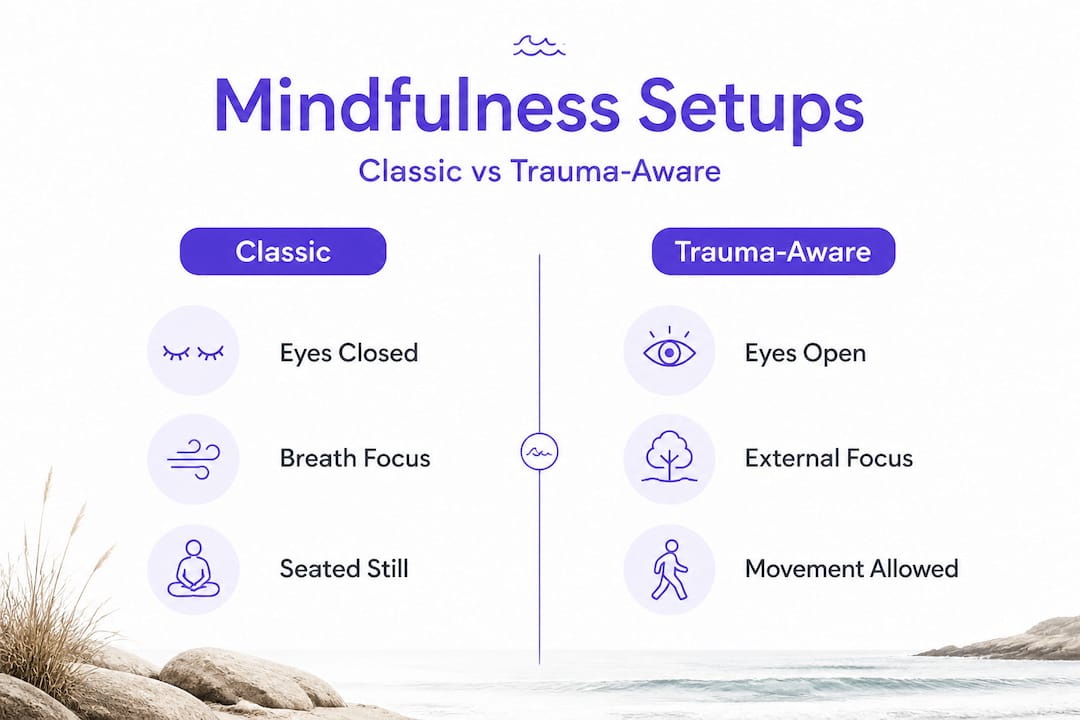
| Classic setup | Trauma-aware setup |
|---|---|
| Eyes closed throughout | Eyes open or soft downward gaze |
| Seated stillness | Seated, standing, or gentle movement |
| Breath as sole anchor | Breath as one option among several |
| Extended sessions | Short, flexible micro-practices |
| Instructor-led commands | Invitational, choice-based language |
| Indoor, quiet space assumed | Any safe space, outdoors included |
Research highlights that trauma-informed adaptations specifically recommend avoiding closed eyes, exclusive breath focus (which can trigger suffocation sensations), enforced stillness, and command-style language. Instead, micro-practices, rhythmic somatic movement, and informed consent are actively encouraged.
Pro Tip: If you are feeling overwhelmed before you even begin, try a 30-second external focus exercise instead. Look around the room and silently name five things you can see. That is a complete and valid trauma-aware mindfulness practice. You do not need to do more than your nervous system can handle today.
Exploring the seven attitudes of mindfulness such as beginner's mind, patience, and non-striving can also reframe how you approach preparation. These attitudes are not rules. They are gentle invitations.
Trauma-aware mindfulness: step-by-step guide
A safe setup means you are ready to try specific trauma-aware mindfulness micro-practices.
The following sequence is adaptive. You do not need to follow every step. You do not need to complete it in order. Think of it as a menu rather than a prescription. Mindfulness for neurodivergent minds works best when flexibility is built in from the start.
- Choose your anchor. This might be the feeling of your feet on the floor, the weight of your hands in your lap, a sound in the room, or the sensation of gentle movement. Breath is one option, not the only one.
- Open your eyes softly. Let your gaze rest on a fixed point slightly downward, or look out of a window. Keeping your eyes open reduces the risk of dissociation and keeps you connected to your environment.
- Start with 60 seconds. Set a gentle timer. One minute of intentional attention is a complete practice. You can extend when and if it feels right.
- Notice without narrating. When your attention wanders, simply return it to your anchor. No commentary needed. No judgement. Mindfulness for stress research consistently shows that the return of attention, not the absence of distraction, is where the benefit lives.
- Allow movement. If you feel restless, shift position, roll your shoulders, or walk slowly around the room. Movement is not a failure of practice. For many trauma-affected nervous systems, it is the practice.
- Use curiosity, not effort. Approach whatever arises with genuine interest rather than determination to feel calm. APA guidance on mindfulness for PTSD specifically highlights non-judgement, curiosity, openness, and kindness as the qualities that make mindfulness-based interventions effective alongside standard therapies.
- Close with grounding. End by pressing your feet firmly into the floor for three seconds, then releasing. This simple act signals to your nervous system that the practice is complete and you are safe.
You are always in control. Stop at any moment you feel unsafe, overwhelmed, or simply done. Stopping is not failure. It is wisdom.
Research on mindfulness-based stress reduction for PTSD shows small to medium effect sizes across meta-analyses, with tailored programmes reducing PTSD, depression, and anxiety symptoms. The key word is tailored. Adapting the practice to the person is not a compromise. It is the point.
Pro Tip: If you notice your breathing becoming laboured or your chest tightening during breath-focused practice, immediately shift your anchor to something external. Place your hand on a surface and focus on its texture. You have just successfully self-regulated using a trauma-aware technique.
Troubleshooting and common mistakes
As you begin these practices, it is normal to encounter a few stumbles. Let us address what to watch out for and what to do if challenges arise.
The most important thing to know upfront is this: up to 83% of meditators experience some form of meditation-related adverse effect, and around 9% experience functional impairment. This is not a fringe finding. It means that struggling with mindfulness is remarkably common, and it is not a sign that something is wrong with you.
Common pitfalls and how to address them:
- Feeling more anxious during practice. Shift from internal to external focus immediately. Try the five-senses grounding technique or stand up and walk slowly.
- Over-focusing on breath. If breath-watching creates tightness or panic, drop it entirely. Use sound, touch, or movement as your anchor instead.
- Discomfort with stillness. This is your nervous system communicating. Honour it. Incorporate slow walking, gentle stretching, or rhythmic movement into your practice.
- Feeling emotionally flooded. Shorten the session. Two minutes is enough. Return to the practice another day when you feel more resourced.
- Frustration with "not doing it right." There is no right. If you noticed something, even briefly, you practised mindfulness.
- Comparing yourself to others. Someone else's calm twenty-minute sitting practice is irrelevant to your nervous system's needs today.
Mindfulness-based interventions are promising as an adjunct to therapy, but evidence suggests they carry higher risks in intensive retreat settings and for those with pre-existing conditions. Screening and monitoring for adverse effects is strongly recommended.
If practices consistently feel unsafe or distressing, that is important information. It does not mean mindfulness is not for you. It means you may benefit from working with a trauma-aware practitioner who can adjust the approach in real time. Exploring mindfulness with a sceptical eye can also help you feel more grounded in why you are doing this and what you are actually looking for.
Recognising progress and building resilience
Knowing what effective trauma-aware mindfulness feels and looks like helps reinforce safe habits and encourages continued practice.
Progress in trauma-aware mindfulness rarely looks like the serene, blissed-out meditator on a wellness app. For people with trauma histories or neurodivergent nervous systems, progress is often quieter and more internal. It might look like noticing you paused before reacting to a stressful email. Or realising you recovered from a difficult moment more quickly than you used to. These are real, meaningful changes.
Progress markers to look for:
| Timeframe | Emotional | Cognitive | Physiological |
|---|---|---|---|
| Short-term (weeks 1 to 3) | Slightly less reactive after practice | Noticing thoughts without acting on them | Slower heart rate during practice |
| Mid-term (weeks 4 to 8) | More space between trigger and response | Improved ability to focus briefly | Reduced muscle tension |
| Long-term (months 3 plus) | Greater emotional stability overall | Clearer decision-making under pressure | Improved sleep and energy regulation |
The neurological evidence is compelling. Brain imaging research shows that mindfulness-based interventions increase grey matter density in areas responsible for emotional regulation and reduce reactivity in the amygdala, the brain's threat-detection centre. Eight out of nine studies in one review found measurable brain structural improvements from regular practice.
Statistic callout: 8 of 9 neuroimaging studies found that mindfulness-based interventions produced measurable increases in grey matter density in emotional regulation brain regions.
For neurodivergent or trauma-affected people, these changes may take longer to appear and may feel less linear. That is completely normal. The unexpected benefits of mindfulness often show up in everyday moments rather than during formal practice, and that is worth celebrating. Small wins are not consolation prizes. They are the actual evidence that your nervous system is learning.
A fresh perspective on trauma-aware mindfulness
With a clearer sense of progress, let us reflect on what truly matters in trauma-aware mindfulness, beyond the checklists and step-by-step guides.
Here is something conventional mindfulness culture gets wrong quite often: it inadvertently pathologises normal trauma responses. When someone cannot close their eyes in a group session, or finds breath-focus activating rather than calming, the implicit message is often that they need to "work on it." That framing is backwards. A nervous system that responds to perceived threat is doing exactly what it was designed to do. The problem is not the person. The problem is the instruction.
Trauma-aware mindfulness is not a gentler, easier version of the real thing. It is the more sophisticated version. It requires more self-knowledge, more honest communication, and more genuine courage than simply following a guided audio track. Choosing to honour your own limits instead of pushing through discomfort is not weakness. It is the kind of self-trust that builds lasting resilience.
We also need to be honest about the wellness industry's tendency to oversell mindfulness as a universal fix. It is not. It is one tool among many, and it works best when it is adapted, supported, and realistic. Understanding how mindfulness, breathwork, and CBT overlap can help you see where mindfulness fits in a broader picture of nervous system care, rather than treating it as the whole answer.
The people who benefit most from trauma-aware mindfulness are not those who push hardest. They are those who stay curious, stay honest, and stay willing to adjust. That is not a soft approach. That is a smart one.
Next steps: expert support for trauma-aware mindfulness
If you have made it this far, you already know that trauma-aware mindfulness is not something you stumble into by downloading an app. It takes real understanding, real preparation, and sometimes real support from someone who knows the terrain.
At Low Tide Calm, we offer trauma-aware mindfulness support through one-on-one online sessions designed specifically for people navigating stress, anxiety, burnout, and neurodivergent experiences. Our structured six-week programmes are built around your nervous system's actual needs, not a generic template. Whether you are brand new to mindfulness or have tried it before and found it unhelpful, there is a pathway that fits. If you want to explore what specialist mindfulness for neurodivergent minds looks like in practice, we would be glad to walk you through it. No pressure, no catharsis, no altered states. Just practical, repeatable tools that work in real life.
Frequently asked questions
What is the core difference between trauma-aware and standard mindfulness?
Trauma-aware mindfulness adapts practices to prioritise safety, choice, and empowerment, following SAMHSA's trauma-informed principles rather than applying a one-size-fits-all approach that may trigger or overwhelm vulnerable nervous systems.
Can mindfulness make some people feel worse?
Yes. Up to 83% of meditators report some adverse effects, which is why trauma-aware adaptations are not optional extras but genuinely necessary safeguards for many people.
What are safe mindfulness practices for trauma survivors?
Trauma-informed adaptations recommend micro-practices of 30 seconds to a few minutes, keeping eyes open, using movement, and anchoring attention on external sensations rather than breath or internal body focus.
How does trauma-aware mindfulness improve resilience?
Regular practice supports nervous system regulation and builds brain resilience by increasing grey matter in emotional regulation areas and reducing amygdala reactivity, which is particularly meaningful for those under chronic stress or with neurodivergent profiles.
Should trauma-aware mindfulness replace therapy?
No. APA guidance is clear that mindfulness-based interventions work best alongside standard therapies rather than as a standalone replacement, and professional support is always advisable for complex trauma histories.